
Literature Database Entry
wieczorek2008applying
Marek Wieczorek, Stefan Podlipnig, Radu Prodan and Thomas Fahringer, "Applying Double Auctions for Scheduling of Workflows on the Grid," Proceedings of International Conference for High Performance Computing, Networking, Storage and Analysis (SC 08), Austin, TX, November 2008.
Abstract
Grid economy models have long been considered as a promising alternative for the classical Grid resource management, due to their dynamic and decentralized nature, and because the financial valuation of resources and services is inherent in any such model. In particular, auction models are widely used in the existing Grid research, as they are easy to implement and are shown to successfully manage resource allocation on the Grid market. The focus on the current work is on workflow scheduling in the Grid resource allocation model based on Continuous Double Auctions (CDA). We analyze different scheduling strategies that can be applied by the user to execute workflows in such an environment, and try to identify the general behavioral patterns that can lead to a fast and cheap workflow execution. In the experimental study, we show that under certain circumstances some benefit can be gained by applying an aggressive scheduling strategy.
Quick access
Original Version  (at publishers web site)
BibTeX 
Contact
Marek Wieczorek
Stefan Podlipnig
Radu Prodan
Thomas Fahringer
BibTeX reference
@inproceedings{wieczorek2008applying,

     author = {Wieczorek, Marek and Podlipnig, Stefan and Prodan, Radu and Fahringer, Thomas},

     doi = {10.1109/SC.2008.5218071},

     title = {{Applying Double Auctions for Scheduling of Workflows on the Grid}},

     publisher = {IEEE},

     address = {Austin, TX},

     booktitle = {International Conference for High Performance Computing, Networking, Storage and Analysis (SC 08)},

     month = {11},

     year = {2008},

   }
Copyright notice
Links to final or draft versions of papers are presented here to ensure timely dissemination of scholarly and technical work. Copyright and all rights therein are retained by authors or by other copyright holders. All persons copying this information are expected to adhere to the terms and constraints invoked by each author's copyright. In most cases, these works may not be reposted or distributed for commercial purposes without the explicit permission of the copyright holder.
The following applies to all papers listed above that have IEEE copyrights: Personal use of this material is permitted. However, permission to reprint/republish this material for advertising or promotional purposes or for creating new collective works for resale or redistribution to servers or lists, or to reuse any copyrighted component of this work in other works must be obtained from the IEEE.
The following applies to all papers listed above that are in submission to IEEE conference/workshop proceedings or journals: This work has been submitted to the IEEE for possible publication. Copyright may be transferred without notice, after which this version may no longer be accessible.
The following applies to all papers listed above that have ACM copyrights: ACM COPYRIGHT NOTICE. Permission to make digital or hard copies of part or all of this work for personal or classroom use is granted without fee provided that copies are not made or distributed for profit or commercial advantage and that copies bear this notice and the full citation on the first page. Copyrights for components of this work owned by others than ACM must be honored. Abstracting with credit is permitted. To copy otherwise, to republish, to post on servers, or to redistribute to lists, requires prior specific permission and/or a fee. Request permissions from Publications Dept., ACM, Inc., fax +1 (212) 869-0481, or permissions@acm.org.
The following applies to all SpringerLink papers listed above that have Springer Science+Business Media copyrights: The original publication is available at www.springerlink.com.
This page was automatically generated using BibDB and bib2web.
- Fed-RAA: Resource-Adaptive Asynchronous Federated Edge Learning with Theoretical Guarantee
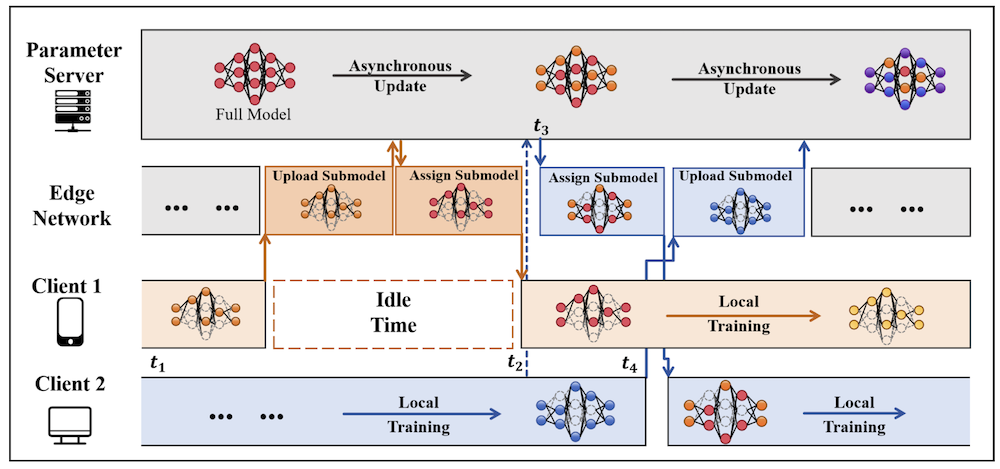
This paper studies an efficient federated learning (FL) problem involving multiple edge-based clients with heterogeneous constrained resources. Compared with numerous ...
- May 27, 2026
Paper Presentation at IEEE ICC 2026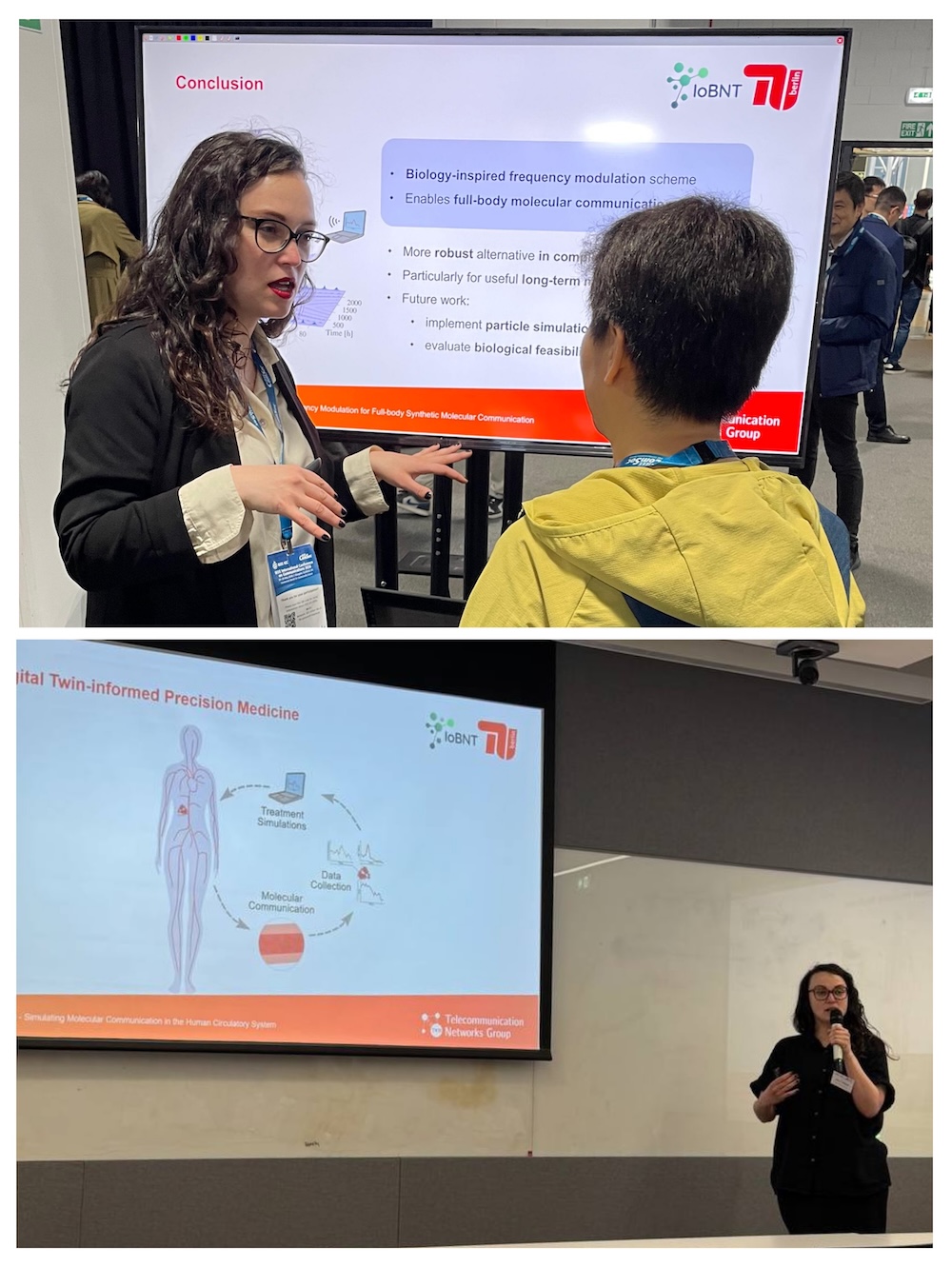
This week, our team member Lisa Y. Debus presented our p... - May 21, 2026
Paper Presentation at IEEE INFOCOM 2026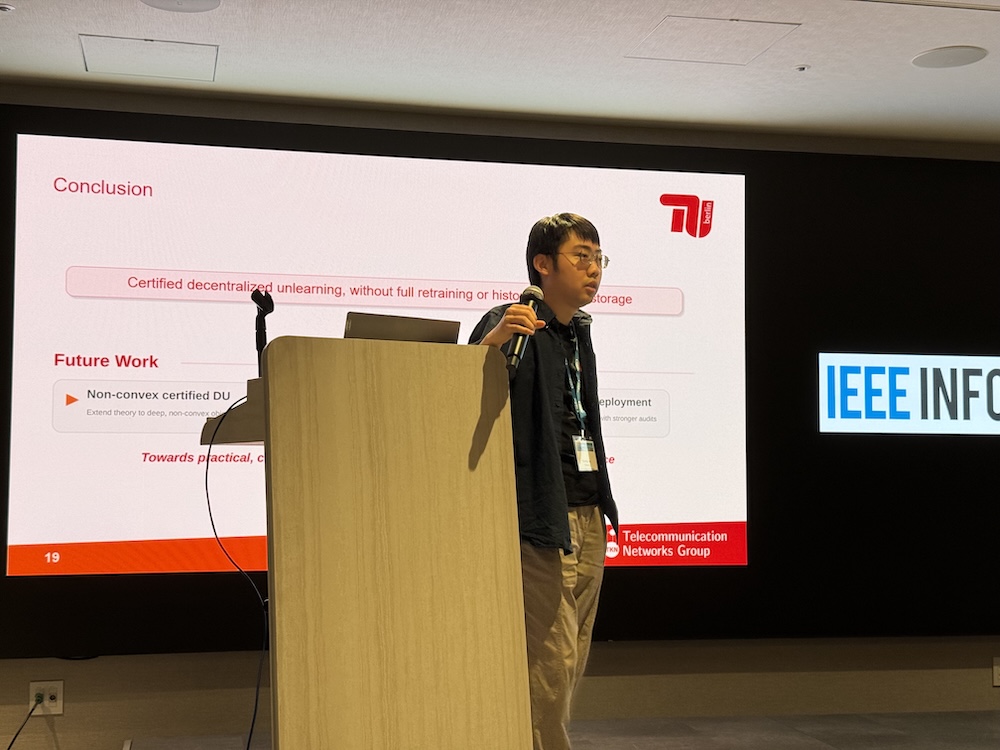
Our team member Dr. Youming Tao presented our paper title... - May 18, 2026
Jorge Torres Gomez Appointed Educational Services Chair of IEEE TWG MBMC
Our team member Jorge Torres Gómez has been appointed as ... - May 18, 2026
TKN at the Annual Berlin Firmenlauf
Some of our team members represented TKN at the annual Be... - May 18, 2026
Paper Presentation at IEEE 6G AI-RAN 2026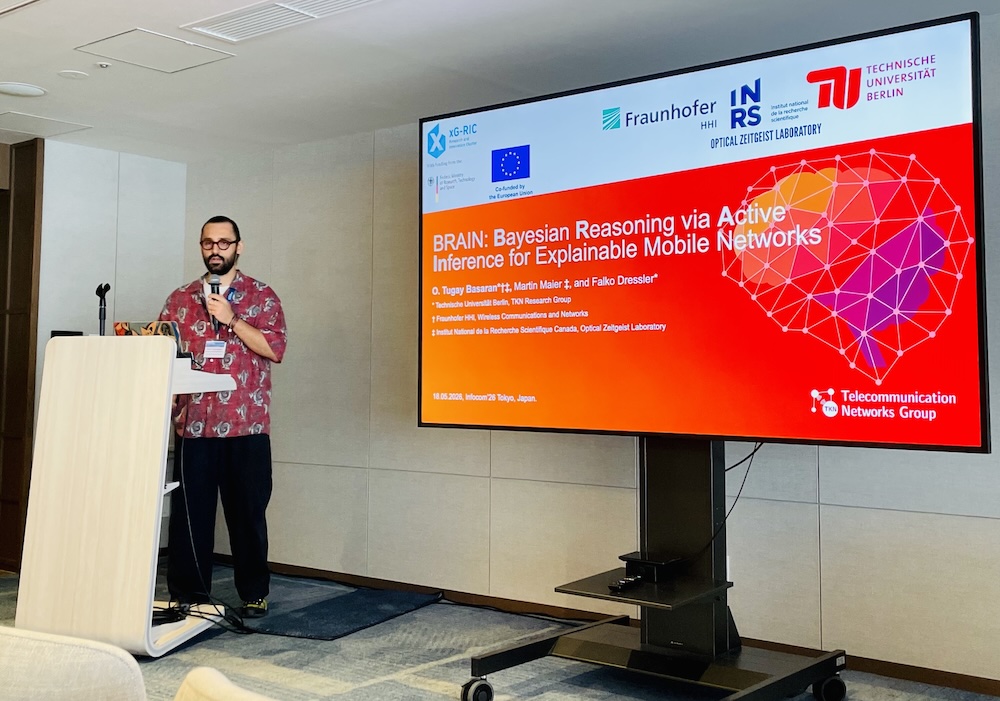
Our team member Osman Tugay Basaran presented our paper t...

