
Literature Database Entry
angjo2025operator
Joana Angjo, Anatolij Zubow and Falko Dressler, "Operator Coexistence in IRS-Assisted mmWave Networks: A Wideband Approach," Elsevier Computer Communications, vol. 244, pp. 108341, December 2025.
Abstract
In sixth generation (6G) mobile networks, the push toward high-frequency bands for ultra-fast data rates intensifies the challenges of signal attenuation and reduced coverage range. Intelligent reconfigurable surfaces (IRSs) present a promising solution to these challenges by enhancing signal coverage and directing reflections, which also contribute to minimize loss. However, there are multiple challenges associated with IRS, which have to be addressed before full incorporation of this technology into existing networks. A key issue arises from the inability of IRS to filter out non-target signals from other frequency bands due to lack of bandpass filtering. In areas where multiple wireless operators are spatially nearby, even if they use different frequency bands, this may cause unwanted reflections that may degrade their communication performances. To address this challenge, we previously proposed a solution, which relied on partitioning an IRS into sub-surfaces (sub_IRS) and dynamically assigning operators to these sub_IRS. Results have shown that a proper assignment of wireless operators to sub_IRS can improve the overall performance compared to a random assignment. In this paper, we introduce a wideband approach, demonstrating that the impact from unwanted reflections can be mitigated by using wideband channels, as the average signal to noise ratio (SNR) across subcarriers is less adversely affected. This approach leverages frequency diversity to reduce SNR variance, as some of the subcarriers may be negatively affected while others benefit, resulting in maintaining a more consistent and robust system performance in the presence of IRS-induced unwanted reflections. Simulations and real-world measurements confirm that the deployment of wideband IRS provides a robust strategy for combating inter-operator reflections in next generation IRS-assisted networks. Additionally, the wideband approach comes at no additional necessity for centralized resource control in future multi-operator networks. According to simulations, the SNR variance for a 1.28GHz channel is approximately 20dB lower than that of a 10MHz channel when coexistence is considered. Similarly, measurements confirm a threefold reduction in SNR variation when transitioning from narrowband (10MHz) to wideband (320MHz) transmission. In overall, the usage of wideband channels in this context allows the system to be more stable and predictable.
Quick access
Original Version  (at publishers web site)
BibTeX 
Contact
Joana Angjo
Anatolij Zubow
Falko Dressler
BibTeX reference
@article{angjo2025operator,

     author = {Angjo, Joana and Zubow, Anatolij and Dressler, Falko},

     doi = {10.1016/j.comcom.2025.108341},

     title = {{Operator Coexistence in IRS-Assisted mmWave Networks: A Wideband Approach}},

     pages = {108341},

     journal = {Elsevier Computer Communications},

     issn = {0140-3664},

     publisher = {Elsevier},

     month = {12},

     volume = {244},

     year = {2025},

   }
Copyright notice
Links to final or draft versions of papers are presented here to ensure timely dissemination of scholarly and technical work. Copyright and all rights therein are retained by authors or by other copyright holders. All persons copying this information are expected to adhere to the terms and constraints invoked by each author's copyright. In most cases, these works may not be reposted or distributed for commercial purposes without the explicit permission of the copyright holder.
The following applies to all papers listed above that have IEEE copyrights: Personal use of this material is permitted. However, permission to reprint/republish this material for advertising or promotional purposes or for creating new collective works for resale or redistribution to servers or lists, or to reuse any copyrighted component of this work in other works must be obtained from the IEEE.
The following applies to all papers listed above that are in submission to IEEE conference/workshop proceedings or journals: This work has been submitted to the IEEE for possible publication. Copyright may be transferred without notice, after which this version may no longer be accessible.
The following applies to all papers listed above that have ACM copyrights: ACM COPYRIGHT NOTICE. Permission to make digital or hard copies of part or all of this work for personal or classroom use is granted without fee provided that copies are not made or distributed for profit or commercial advantage and that copies bear this notice and the full citation on the first page. Copyrights for components of this work owned by others than ACM must be honored. Abstracting with credit is permitted. To copy otherwise, to republish, to post on servers, or to redistribute to lists, requires prior specific permission and/or a fee. Request permissions from Publications Dept., ACM, Inc., fax +1 (212) 869-0481, or permissions@acm.org.
The following applies to all SpringerLink papers listed above that have Springer Science+Business Media copyrights: The original publication is available at www.springerlink.com.
This page was automatically generated using BibDB and bib2web.
- Wi-Lo++: WiFi-to-LoRa Cross-Technology Communication with Multi-Packet Emulation
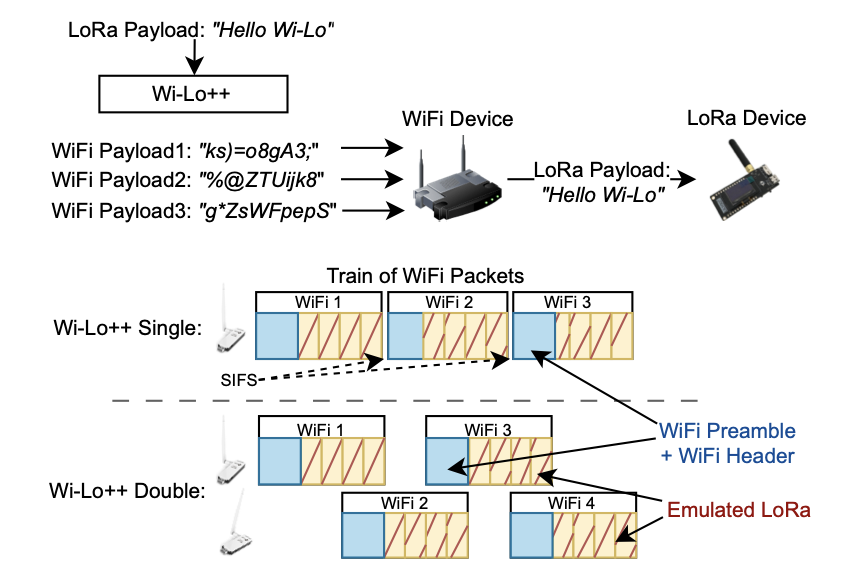
LoRa was developed for long-range communication in internet of things (IoT) applications, also in the 2.4 GHz ISM band. However, native LoRa support remains limited in...
- October 08, 2026
New IEEE Transactions on Mobile Computing article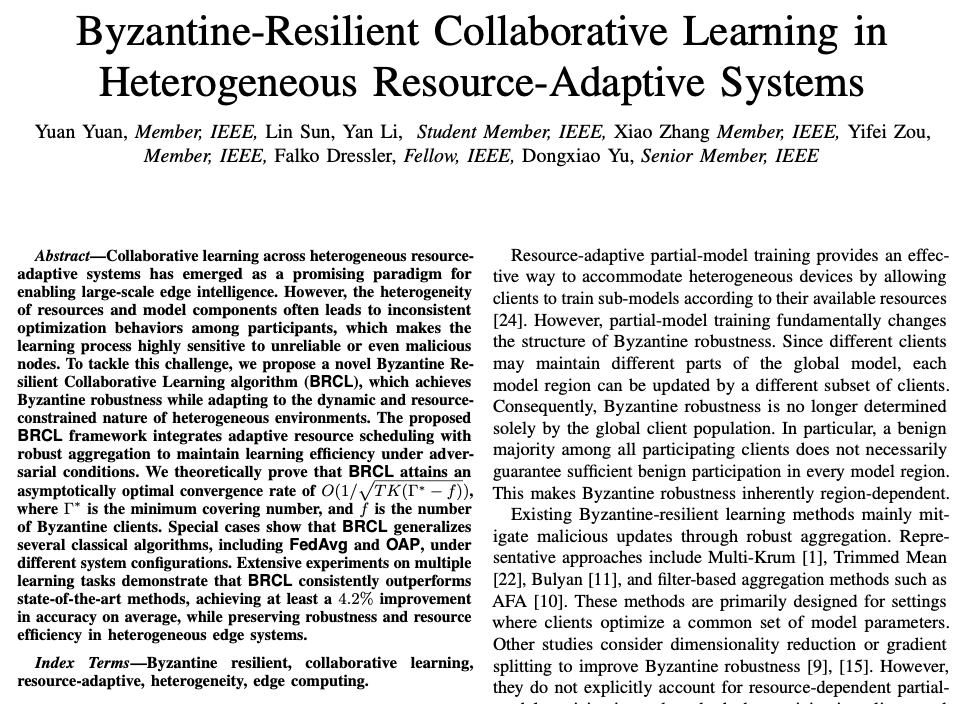
Our article Byzantine-Resilient Collaborative Learning in... - October 02, 2026
KuVS Research School on Network and System Resilience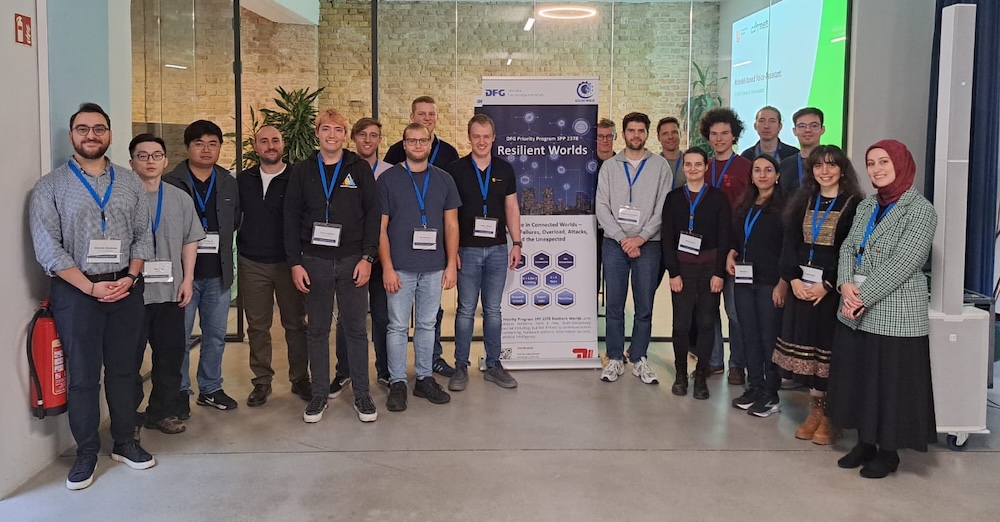
Our group member Dr. Doganalp Ergenc organized the KuVS R... - September 26, 2026
New IEEE Transactions on Mobile Computing article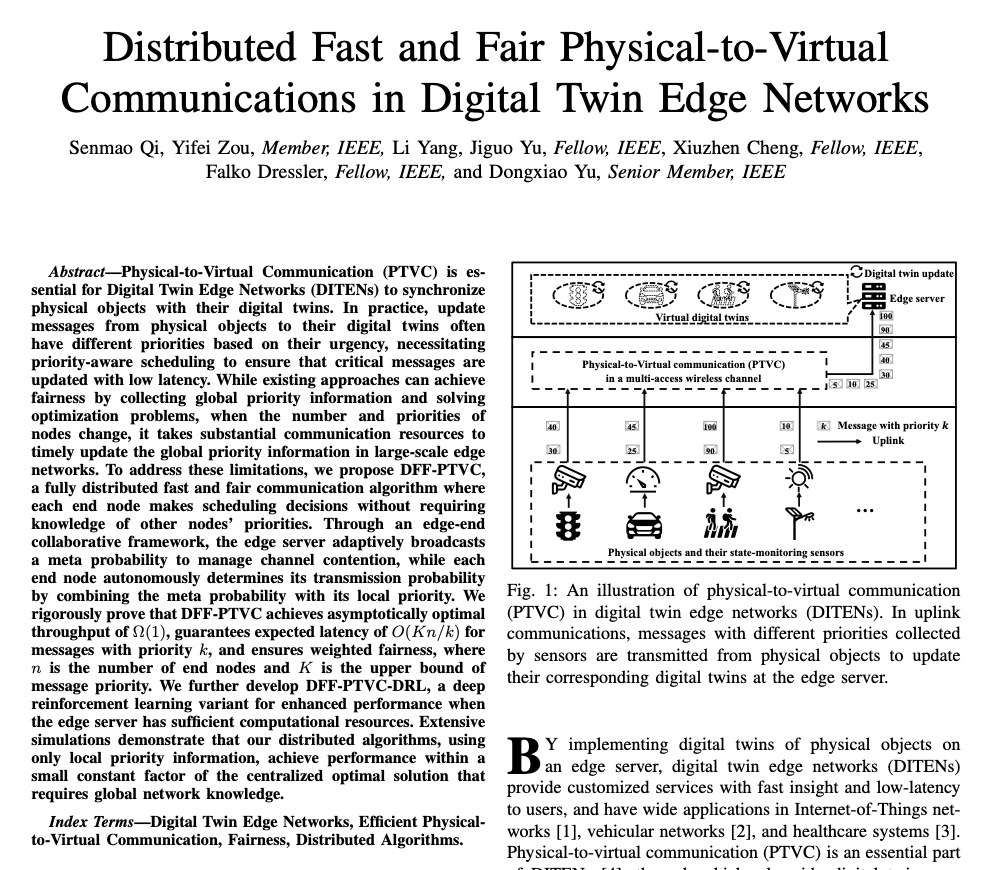
Our article Distributed Fast and Fair Physical-to-Virtual... - September 23, 2026
TKN Team at ACM NanoCom 2026
Our team presented their research at the 13th ACM Interna... - September 22, 2026
New IEEE Transactions on Networking article
Our article One-Shot Federated Model Editing for Device D...

